Thanks to the hard work of our friends at Sans Soleil, “Forest and Factory: The Science and the Fiction of Communism” has been translated into French. This edition includes a new preface that coauthor Phil A. Neel and I wrote together, which is reproduced in English below. Here we further elaborate the importance of both utopian and scientific thinking, and the necessary role their mutual tension plays in the communist movement.
You can also find this preface, in addition to a trove of other insightful and syncretic writing, at Phil’s substack The Planetary Factory. I highly recommend subscribing to his blog and reading his new book Hellworld: The Human Species and the Planetary Factory, out now in hardcover from Brill and soon in paperback from Haymarket Books.
Links:
- French translation “Fabrique et forêt: Science et fiction du communisme”
- Original publication via Endnotes Palabre
- Translations into other languages, printable formats
- The Planetary Factory
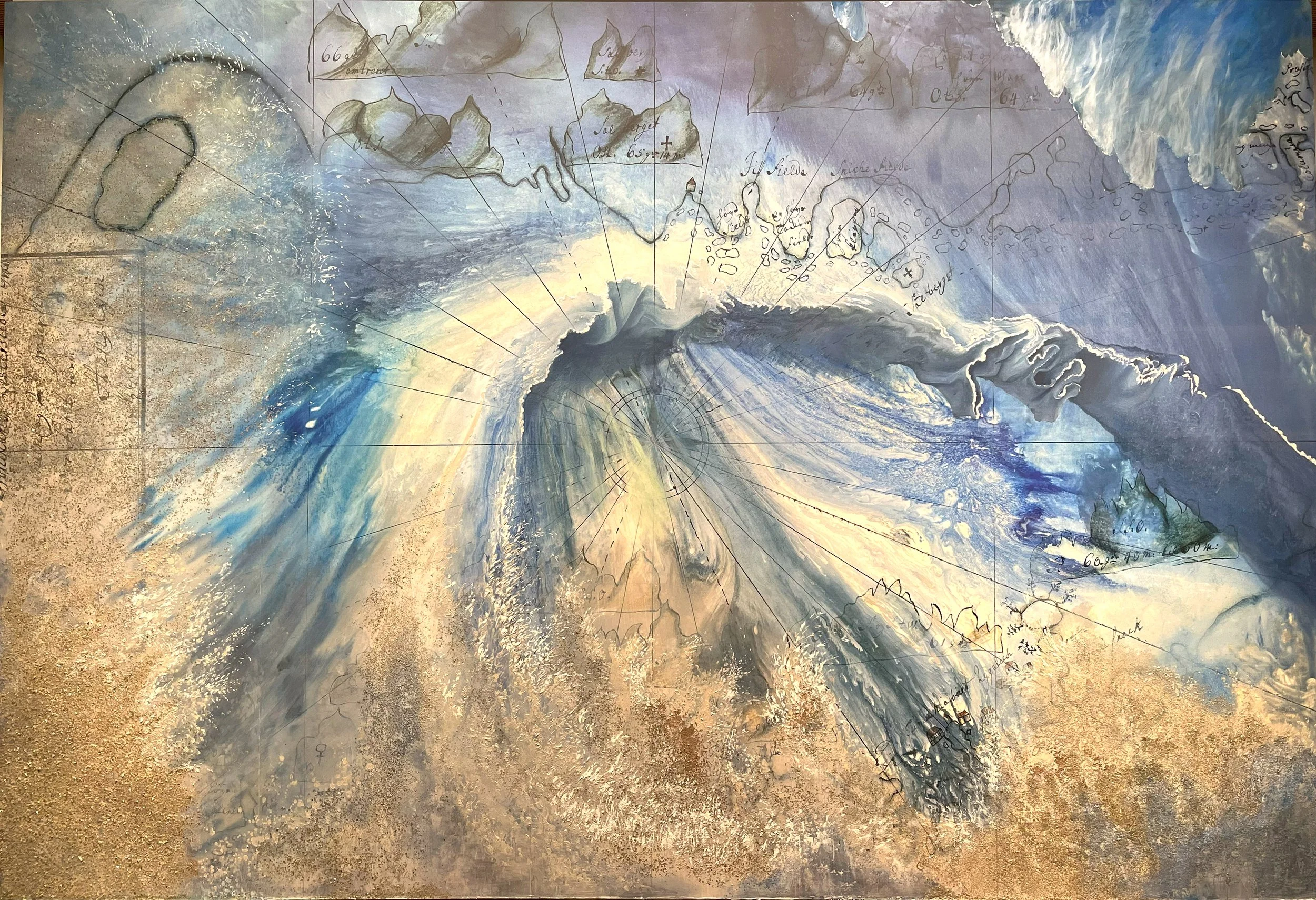
Image: Firelei Báez, Untitled (Map of Greenland’s west coast, 3 degrees south of the colony and 2 degrees north of the colony; year 1724, explored by Hans Egede, missionary), 2023, acrylic and mica on digital print transferred to vinyl, 180″ x 268″
Like mirages shimmering across the sun-hot stone at the desert horizon, utopias take shape under the oppressive heat of repression in shattered places long starved of practical nourishment. For this reason, utopian thinking is best characterized as first an artistic or, at best, philosophical exercise, with its properly-political dimensions amended atop a primarily aesthetic sense of longing for a better world – a longing that is, as a rule, expressed within the terms set by this one. This is not to say that utopianism plays no political role, however. Often, fictive utopias take practical shape long after their initial publication, when they serve as referents for later generations of political actors. Take, for example, the prototypical modern utopias, beginning with Thomas More’s Utopia, which was first drafted in 1515 while More was an envoy to the Low Countries (one of the gestation chambers of modern capitalism). Though primarily literary, the text was nonetheless a meditation on political themes. More himself was a devout Catholic statesman and, for a brief period, a merchant. His utopia was, at least in part, an attempt to come to terms with a world in which the inherited order was being upended by the Reformation, by growing commercialization, and by Humanistic principles that he himself sympathized with – the latter influenced by a reengagement with texts from antiquity and by broader cultural contact with Asia and the societies of the “New World.”
More’s prototype would then be deployed in a variety of religious, republican, and socialistic utopias throughout the modern era, each of which had both a literary and practical character. For example, Vasco de Quiroga drew on More’s book in structuring the nascent settler-colonial polity in Michoacán while serving as its first bishop in the 1540s. Nearly a decade after its original publication, elements of More’s thought were thereby translated into a concrete political program founded on the forced relocation and assimilation of the indigenous population. As the colonial context of this case demonstrates, early utopian schemes were most often premised on actualizing what was apparently a literary device: the location of “utopia” in a “no-place” beyond the ken of modern society. Politically, this was rendered as a form of secession or exit from the prevailing social system which, in practice, entailed the founding of utopian colonies in territories sited at or outside the spatial boundaries of metropolitan power. In effect, however, these colonies were simply aspects of the larger flows of migration and spatial settlement that helped implant capitalist social relations both across the globe and deeper into the countryside. Though posed as heresies against the nascent capitalist order, these utopias were ultimately avant-garde deployments of that very order.1 Meanwhile, themes and language from the utopian tradition also seeped into the social reformism pursued by certain sections of the elite.2
In retrospect, we can perhaps argue that this utopianism was nonetheless a necessary step in the formation of a practical and scientific communist politics. After all, Marx’s own thought develops through an essentially dialectical process of criticism in which earlier socialist currents – and particularly the utopian thought of figures like Saint-Simon and Fourier – are recognized as embodying a certain spirit of emancipation but also ruthlessly deconstructed to demonstrate how, exactly, their formulations remain trapped within the mystified image of bourgeois society and thereby serve to uphold it. By contrast, communism is posed by Marx and Engels as an essentially scientific endeavor rooted in an incisive critique of the very social givens that make utopian fictions familiar and effective ideological interventions. Utopianism muddies this process of demystification and, in so doing, leads to strategic dead ends in practice. To avoid this outcome, anti-utopian approaches impose a strict methodology on theory, which must be both internally rigorous (consistent, self-critical, etc.) and attentive to observed trends in the surrounding world. And yet, given its emotive power and enduring popular appeal, utopian fiction nonetheless remains an indispensable practical tool. Socialist history is therefore marked by a long-standing tension wherein the stringent, theoretical opposition to utopian depictions of communism coexists with recurrent violations of this proscription in practice, given the utility of utopia in communicating communist ideas to a general audience.
For example, in the same years that Marx and Engels began to exert a widespread influence on the socialist movement, utopian texts continued to serve as popular entry points for socialist politics. Bestselling books like Edward Bellamy’s Looking Backward: 2000-1887 (published in 1888) fleshed out modern images of a socialist society in a matter-of-fact fashion. While the scientific socialism of Marx and Engels certainly exerted a deeper influence among intellectuals and socialist militants, books like Looking Backward had a much broader impact on early perceptions of socialism across the population as a whole.3 In Bellamy’s case, the text also spawned a series of “Nationalist Clubs” (named for his emphasis on the nationalization of industry) through which readers sought to popularize the text and carry forward its political vision. Similarly, several utopian communities inspired, at least in part, by Bellamy’s ideas were formed across the US.4
In 1890, and William Morris then released his own utopian novel, News from Nowhere (1890), as a libertarian socialist rejoinder to Bellamy’s state-socialist vision. Though less popular than Bellamy’s bestseller, News from Nowhere was notable as an attempt to elaborate what was essentially a political polemic against one utopian vision through the means of utopian fiction itself. Even though Marx and Engels had themselves been adamant critics of utopian thought, both Bellamy and Morris also presented their own utopian thought experiments as running in parallel with a modern, materialist, and loosely Marxian socialism, rather than rehashing the idealist and secessionist utopias of older figures like Saint-Simon and Fourier. While both authors explicitly gestured toward Marx, however, only Morris had any real familiarity with his work. Over the preceding decade, he had presided over the Socialist League in Britain, overseeing the publication of its weekly newspaper Commonweal, which ran work by figures like Paul Lafargue, Wilhelm Liebknecht, Karl Kautsky, and Engels (whom Morris had been personally introduced to by Ernest Belfort Bax and Edward Aveling in the 1880s).
In Russia at the end of the 19th century, an even more advanced version of utopian thought then emerged among the cosmists. Cosmist philosophers like Nikolai Fyodorov attempted to synthesize technological, evolutionary-biological, and religious themes drawn from Russian Orthodoxy into a singular teleological narrative that Fyodorov referred to as the “Common Task.” The grand Task of the species included everything from seeding humanity across the cosmos to advancing science to such an extent that humankind would be able to achieve immortality and revive the dead. Working as both scientists and philosophers, cosmists piloted early theories of transhumanism, ecology, geoengineering, and aeronautics. As artists, they elaborated on themes drawn from science fiction, early socialist thought, and Western mysticism. Cosmist figures such as early rocket scientist Konstantin Tsiolkovsky published their own works of hard science fiction, mostly exploring the potentials of space travel.5 Despite their affinity for Christianity, most were also sympathetic to the modernist impulse of the Russian left. Cosmist ideas therefore enjoyed widespread popularity within the cultural milieus traversed by Russian Marxists and were absorbed piecemeal into the Bolshevik project, from whence cosmist themes would go on to influence early Soviet culture.6
In all cases, these modern utopias, now operating within the loose conventions of early science fiction, proved to be an extremely popular medium through which basic socialist ideas could be communicated and colloquial objections to the socialist project responded to. As socialist parties grew, fictional accounts like this served an essential practical function in attracting and training an entire generation of socialists, operating hand-in-hand with party programs and simplified popular texts like Kautsky’s The Class Struggle, August Bebel’s Women and Socialism, and Bukharin’s The ABC of Communism. The same tension then reemerged within the New Left, where the theoretical reframing of utopianism by Ernst Bloch and the new humanism of figures like Herbert Marcuse helped reopen the imaginative field, while the revival of romanticism across the arts (accompanied by a popular mysticism) and the new-style social science fiction of authors like Ursula Le Guin helped give this new utopianism artistic shape.
Nonetheless, as the communist movement suffered its long tragedy and gradually fell into eclipse, utopian thinking grew increasingly unmoored from the scientific process that counterbalanced it. The material community of capital encrusted itself across Earth’s surface and utopian thought was once again reduced to little more than an artistic expression of yearning for a better world, increasingly delinked from any practical attempt to transcend this one. The collapse of the communist movement also saw the reduction of politics back down to its moral roots, evident in the revival of the classic utopian colony. Thus, a revival of interest in secessionist rural communes similar in kind to the cooperative colonies of the 19th century was manifested in the left-leaning communitarianism of the Back to the Land movement. As repression intensified in the 1970s, these secessionist projects simultaneously became a sort of shelter against the storm and a justification for what was, ultimately, a conservative retreat from the cities parallel to (and arguably one manifestation of) the more general process of white flight, which would see right-wing bastions built up in suburbs and small towns over the same decades. Gradually severed from practical politics, utopian socialism slowly returned to its roots in the settler-colonial imaginary.
From there, utopianism only grew more distant from the surrounding world. In contrast to even the Back to the Land communes and the Fourierist colonies of the 19th century, today’s utopian schemes are rarely tested against even the most rudimentary of practical limits. Meanwhile, unlike the theory-fiction of figures like Bellamy, Morris, or Tsiolkovsky, the boom in utopian thinking over the past few decades has emerged in the absence of a coherent “left” operating through organizations that have any mass appeal. As a result, today’s utopias tend to take on, at best, a “pseudo-political” character, if not a purely literary one. And yet they are nonetheless an expression of the material conditions that underlie them, much as the mirage, though “illusory,” is also a material phenomenon generated by a unique interplay of heat and light on barren soil. Whether rendered into a coherent political project or not, utopias are ultimately fictions created by a certain confluence of class forces at a particular moment in history. For this reason, the specific character of their fantasy, even if only pseudo-political, is itself a diffuse reflection of the actually-political conditions from which it emerged.
Today, the most salient structuring factor in utopian thinking is the general degradation of productive subjectivity induced by deindustrialization. Visions of emancipation via “direct democracy” and localist lifeways are simply crude inversions of our present reality rather than a serious societal vision capable of withstanding basic scrutiny. As larger shares of the population are ejected from the immediate process of production, the vast and intricate networks of labor, machinery, and infrastructure continually reassembling earthly matter into an apparent infinity of commodities all grow increasingly inscrutable. For many people today, the immediate process of production is effectively invisible. Thus, rather than starting from the essential question of how production is actually organized and how it might be reorganized on a simultaneously social and technical level, contemporary utopias internalize the inscrutability of industry, assuming that modern industrial production is unnecessary or even undesirable or, in some cases, making even more dubious claims that production can become so automated that it requires little-to-no active human participation. These are just two inverted versions of the same illusion: that the practical and intellectual capacities which enable modern production are not politically salient and their transformation would therefore be a purely technical problem, not relevant to the larger question of how a communist society would operate.
Forest and Factory is intended, in part, as a counter to these impulses, posing the relative rigor of “hard sci-fi” against the various forms of magical thinking conditioned by distance from the productive sphere. We also draw on properly communist theories of collective planning and deliberation (necessarily deployed at the planetary scale) to illustrate the ultimately conservative impulse of all forms of communitarian thought, including visions of a direct-democratic confederation of localities. Moreover, we stress the tension that arises between understanding communism as a fundamentally anthropological revolution that will generate a world which is in many ways alien to our own, and the practical need to render this vision in commonsense terms. This is why we characterize our own intervention as an “anti-utopian utopia,” recognizing the scientific thrust of communist theory while nonetheless acknowledging that utopianism is one means through which the people inhabiting our own historical confluence can first come to measure the actually-existing world against what is possible. When a new political era reemerges, as it now has, fictive procedures can help to congeal the subconsciousness of the class, preparing the field for the emergence of a rudimentary subjectivity.
Subjectivity must, however, be understood as a fundamentally collective category, rather than an individual, ideational one: the productive subjectivity of the collective worker as a whole, embedded as much in hands-on knowledge as in abstract forms of scientific practice, or the revolutionary subjectivity of a class organized to overthrow the conditions that produce it. In other words, communism does not emerge from the mind. It is instead constructed through the cooperation of many hands first seizing control over our present society and then constructing a better one from the pieces. Since this revolutionary endeavor – itself only the initial sequence of steps in our “Common Task” – is geared toward the construction of a social order entirely unprecedented in human history, utopian literature is primarily concerned with illustrating the contours of this fundamentally unfamiliar social order, translated as best as possible into familiar terms. But, at the practical level, the utopian text itself does not play any role in the construction of that society. It is not, in other words, an actual “blueprint” for the future. Instead, the practical function of utopian thought is its ability to break the illusion that this is the only possible world and thereby attract adherents to the concrete political projects through which a social force capable of undertaking the grand task of revolution is brought into being.
From within the depths of contemporary class struggle, the most pressing task faced by communists today is the need for emergent, ephemeral forms of organization, which express a tumultuous and inchoate form of pre-subjective consciousness, to be anchored and linked together into a more expansive political subjectivity that can operate on not just a tactical level, but a strategic one. Regardless of how strictly anti-utopian we are in theory, utopian fiction that sketches out the broad contours of a communist society has always been an invaluable aspect of partisan organizing. Attempts to articulate the type of society being fought for and planned towards in colloquial terms – and to thereby illustrate the elements of the present society that must be done away with – are an inherent aspect of how revolutionary subjectivity develops, as are theoretical critiques of this very utopianism and practical challenges to both. In other words, the reawakening of communist consciousness occurs through a dialectic of anti-utopianism and utopianism, science and fiction, rigor and imagination, all wrenched together by historical circumstance. Driven forward through these propulsive oppositions, this dialectic is then grounded by the practical problems thrown up in the living process of class struggle, which must be addressed through the fictive articulation of what we are fighting for, the practical appraisal of how to get there, and the theoretical elaboration of what we are fighting against.
Forest and Factory is both a plea for more rigor and an attempt to lead by example, contrasting a “hard science fiction” approach against a purely “speculative” one. For us, utopian fiction must be “scientific” in the sense that it recognizes: a) the ultimately unknown nature of our object of inquiry; and b) the need to apply realistic practical constraints in discussions of both production and the revolutionary sequence that will lead to a communist society. Above all, we argue that production itself is a site of political struggle and must be treated as such. As the cadence and intensity of class struggle increases, it will be even more important to integrate the strata of the workforce who possess the intimate forms of knowledge necessary to appropriate and transform the existing means of production. In our present moment, the utility of this knowledge for class struggle is limited, save for when it is purposefully withheld in the form of a strike. But, in the long term, these capacities will be foundational for the construction of communism – a social metamorphosis rooted in the appropriation, reorientation, restructuring, and, ultimately, transformation of both the social and technical character of the existing means of production. Understood as a long-run process of social-metabolic reconfiguration, the question of production is at the very heart of the communist project. In taking shape, revolutionary subjectivity must therefore grapple with the uneven distribution of productive knowledge throughout the proletariat and the fractalized inequities that structure it. Our hypothesis is that applying the principles of hard science fiction and anti-utopian theory to the utopian imaginary itself will serve a practical purpose insofar as it draws people to the revolutionary project and, in particular, helps to cultivate revolutionary subjectivity across the technical strata of the workforce. We leave further experimental verification of this hypothesis to the reader.
Communism is, after all, a scientific endeavor. And yet, the point is not simply to model the world in theory, but to change it in practice – and to do so deliberately, with specific goals in mind. In this sense, communism is also an engineering project, understood as a scientific process with a final objective, which the Cosmists would call our Common Task. This Task is, above all else, the suffusion of human reason across the entirety of society, enabled by free and cooperative social relationships no longer premised on domination, thereby saturating all facets of human social existence with conscious, deliberate, and collective intention such that every human being can fully and freely participate in society and enjoy the fruits of all collective labor, living and dead, secured indefinitely into the future. To render utopia as a future reality rather than a fictive non-place, we must construct a social force capable of not just seizing the seat of social power from its current occupants but also inscribing the social logic of communism into the very material-productive substrate of the species. In all of these senses, we can therefore draw from the Cosmists to speak of communism as a form of immortalism: an immortal science that is ultimately an engine of both the figurative immortality of the species – human reason etched into the metabolic flux of the planet such that it becomes the self-renewing font of communism – and a literal immortality, insofar as the collective birthright embodied in all dead labor, past and future, can finally be realized and our debts to the martyred struggles of the past repaid.
1 Examples include the 19th century Fourierist colonies in places like Texas (La Réunion near Dallas, 1855) and rural France (the Familistère in Guise, 1846) or the anarchist and populist colonies in the US Pacific Northwest founded later in the century, such as Home (1898) or the Puget Sound Co-operative Colony (1887). The Puget Sound Co-operative Colony offers a particularly telling illustration of the settler-colonial logic of these projects. Sited near modern-day Port Angeles, the co-op was located on the customary site of a seasonal village long used by indigenous people. As reported in the co-op’s newspaper: “beach lands, which six months ago were the habitation of Indians only, now hums with the voices of nearly 300 people … when the neighboring Indians in their numerous canoes came, as they were long accustomed, to land, found no place to pitch their tents as of yore, looked and wondered for a while and then moved on, only a remnant remaining.” (Qtd. in Charles Pierce LeWarne, Utopias on Puget Sound 1885-1915, Seattle, WA: University of Washington Press, 1975. p.34)
2 This was, in part, an aspect of the political strategy pursued by figures like Saint-Simon and his followers, who made frequent appeals to the upper classes and, later, joined with sympathetic elites in planning megaprojects such as the Suez Canal.
3 For reference, the first German edition of Capital was published in 1867 and only 1,000 copies were printed. The first English translation didn’t appear until 1887, and sales were similarly slow. By contrast, after Bellamy’s Looking Backward was reprinted by a larger-scale publisher in 1889, it sold more than 400,000 copies over the subsequent decade.
4 These included Ruskin Colony in Tennessee (1894), the Equality Colony in Washington (1897), Bellamy Cooperative Colony in Oregon (1897), and Kaweah, in California (initiated in 1886 but then reconceived along Bellamyite lines and legally established in 1888).
5 Cosmist fiction also built off earlier Russian speculative fiction by figures like Dmitry Sigov (whose Voyage to the Sun and Planet Mercury and All the Visible and Invisible Worlds was published in 1832) as well as socialist utopian fiction such as Nikolai Chernyshevsky’s What Is to Be Done? (authored in 1863,the title of which would later be used for Lenin’s better-known pamphlet).
6 In literature, the cosmists and earlier utopian thinkers also set the stage for later hard sci-fi authors such as Alexey N. Tolstoy and Alexander Belyaev. In the visual arts, cosmist themes exerted a major influence on everything from Suprematism to the experimental cinema of Dziga Vertov. Many of these themes would later be encoded in contemporary sci-fi via the later work of figures like Arkady and Boris Strugatsky and of course Andrei Tarkovsky.
Leave a Reply