A recurring theme across my writing is that of communist transition’s necessary features, with emphasis on systems of production and the embodied expertise necessary for their appropriation and reconfiguration. In particular, I try to approach this topic from a heuristic register rather than a prescriptive one. Rather than trying to presage the conditions under which transition occurs and then crafting tactics and strategies attuned to that imagined context, I think it is more useful to instead work out the core of what will need to happen in the course of communist construction.
To answer that, it is necessary to understand how our present capitalist world is continually produced and reproduced at a material level. This enables the formulation of a positive image of communist society—both in a contrastive sense (it is not capitalism) but also in a constitutive sense: the present world sets the terms for any future world that emerges from it. We attempt exactly this in Forest and Factory (2023) which, despite its forward-facing focus, is ultimately about understanding the destination in service of navigating the path we currently tread. As we state in the conclusion:
Attentive readers will have already noticed that we have not so much provided a picture of communism itself as posed a series of questions about the sequence, character, duration, and constraints of the process of what we have referred to as “communist construction.”
But there are other, similar ways this path can be mapped. An image of the future, even if speculative, and a description of the present still need a connecting line drawn between them. It is necessary to describe what features of our present must change such that, as they change, that line is traversed towards that destination. Moreover, it is necessary to describe how they must change. In other words, this maneuver is the theorization of that sequence and its character, duration, and constraints.
With production being the fundamental human activity through which social relations are expressed, I attempt to describe the most salient features of that arena with an eye for their fundamental reconfiguration. The Black Box of Production, available now on Heatwave’s website ahead of the print publication of Issue 3, theorizes a framework for understanding the social distribution of technical expertise in capitalism. Specifically, it elucidates capital’s innate tendency towards a concentration of this technical expertise among a minority of the human species, and it develops a typology of technical expertise in service of conceptualizing how each type is differentially related to the task of communist construction. It is a spiritual successor to a similar piece of mine, Technical Expertise and Communist Production, originally published in The Brooklyn Rail (2022).
If you find this compelling, I highly recommend either subscribing to Heatwave magazine via Patreon or seeking out hard copies from distributors across North America, Asia, Australia, and Europe. Older issues are uploaded in full on the website once the following print issue ships out, meaning that as of the publication of this blog post you can read the entirety of Issue 1 and 2 online, with the entirety of Issue 3 slated to be fully online once Issue 4 ships out. I strongly recommend reviewing this back-catalogue for some excellent writing.
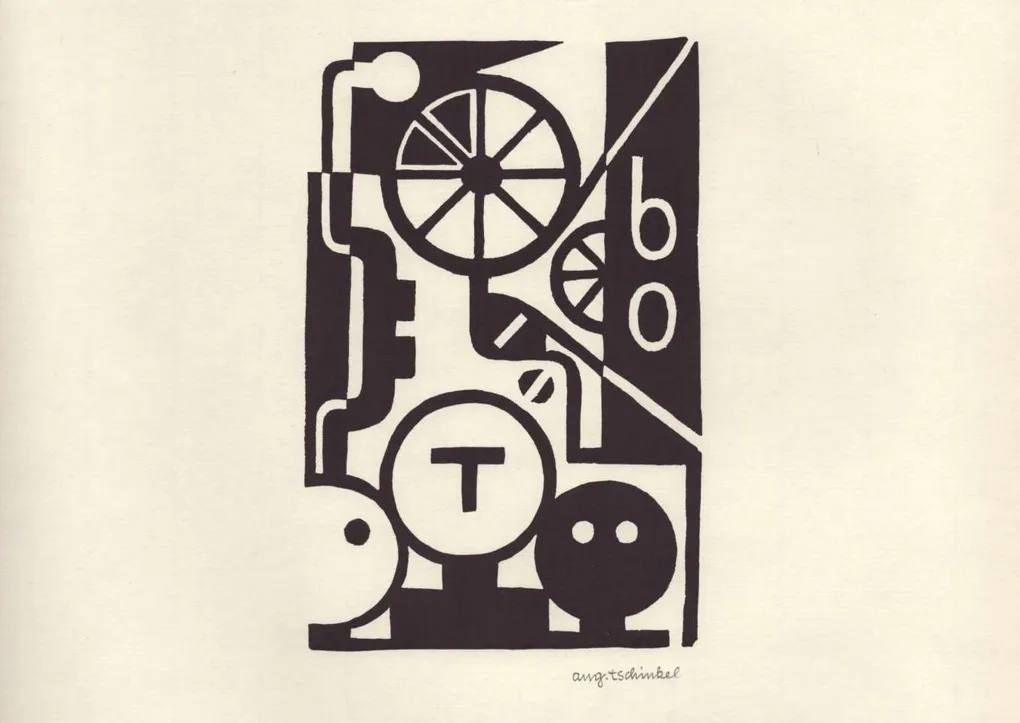
Image: Augustin Tschinkel, Untitled
Capitalism hides a world-spanning system of production, a veritable global factory, behind even the most mundane commodities. What appears as a common object on a store shelf or a simple quantity of currency is really the secretion of a global social system wherein the collective labor of the human species reshapes vast quantities of terrestrial matter into forms amenable to profit above all else. With capitalism’s enclosure of the globe, the total weight of anthropogenic mass—i.e. the concrete, steel, glass, drawn copper, plastic, and other materials we shape into the seemingly-infinite forms of the commodity—is now larger than all biomass on Earth. The material world, made and re-made in the image of capital, looms large over humanity’s future.
To place humanity’s destiny back in our own hands, the process of communist construction will require grappling with capital’s literal encrustation on the planet’s surface. If this world was made how it is through human labor, it can also be made into something else through human labor. In order to not only dismantle the machinery of planetary capitalism, but to also then repurpose its components into a planetary communism worthy of the name, it will be crucial to leverage the relevant technical expertise currently held by the industrial workforce. Industrial know-how is, of course, not the only relevant expertise to communist construction. But it is essential and frequently overlooked by communists for whom the global factory is simply a black box beyond the horizon of day-to-day imagination. The question of how to carry out this restructuring cannot be answered properly without the variegated forms of industrial, technological, and scientific knowledge cultivated in the relevant portion of the global proletariat, of which it constitutes an increasingly small minority.
A central challenge for the task of communist construction is therefore the leveraging and deployment of technical expertise. This expertise is not internally homogeneous, and therefore has a multifaceted relationship to the communist project. The deleterious effects of its uneven distribution must be corrected whilst simultaneously leveraging the capacities it engenders as they happen to exist. This has deep implications for present-day communist politics—chiefly the horizon of political imagination and the strategic dimensions of class struggle. But the current makeup of this technical expertise also portends, however hazily today, the contours of communist construction’s central challenge: the breaking of this mode of production and the creation of a new one. In order to conceptually map this corpus of knowledge and theorize its implications, it is important to first understand how capitalism currently distributes it.
Read the rest on Heatwave’s website now, and find it in print in Heatwave Issue 3.
Leave a Reply